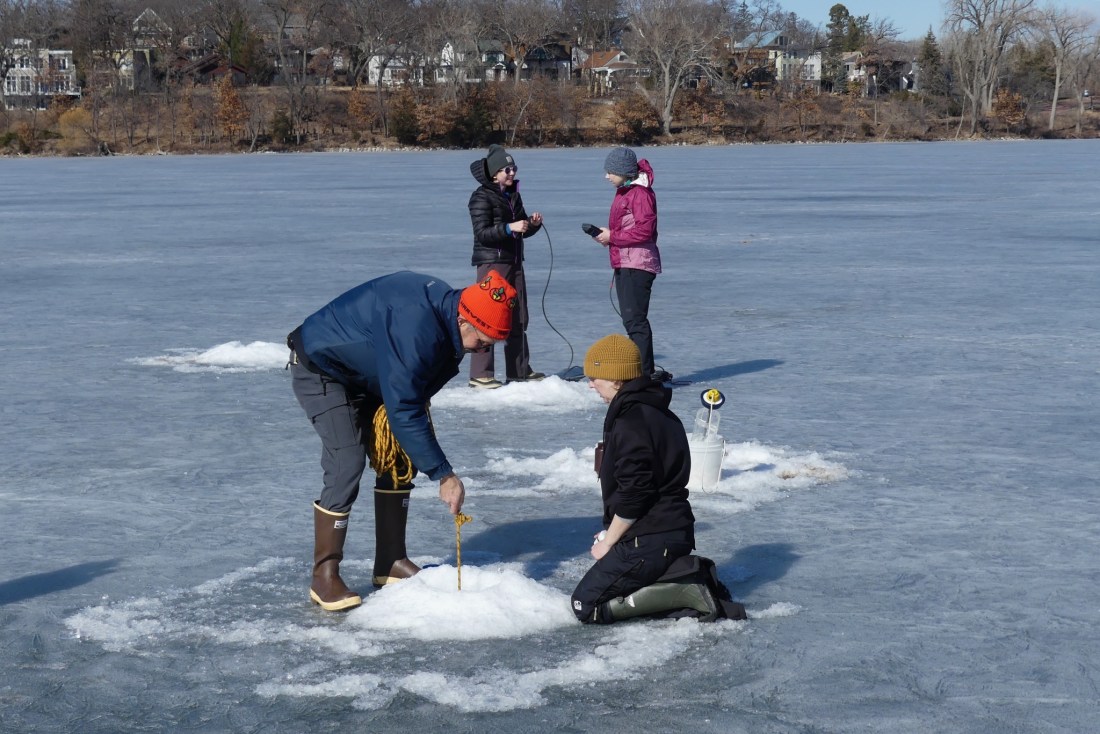
*Photos and quotes for this article were collected by Greg Seitz for an article in Agate Magazine.
Nestled in the woods on the banks of the St. Croix River, just outside of Marine on St. Croix, sits a world-class research institute with five state-of-the-art laboratories, including a 1,000 square foot analytical lab, a sediment-dating lab, gamma spectrometry radioisotope tracer lab, wet lab, and microscopy lab. The St. Croix Watershed Research Station is affiliated with the Science Museum of Minnesota and studies issues affecting lakes and rivers in Minnesota, including eutrophication (excess nutrients), toxic pollutants, climate change, erosion, sedimentation, and biodiversity. One of the center’s current projects examines the growing impact of chloride (salt) on our freshwater resources.

“Picture an African elephant standing about every 90 feet along a busy highway,” says Hailey Sauer, a postdoctoral researcher with the SCWRS. “That’s the average amount of salt applied to Minnesota roads each year.”
In the Twin Cities metro alone, an estimated 365,000 tons of road salt are applied to roads each winter. Of this, 78% is transported to groundwater or remains in local lakes and wetlands. Chloride is toxic to freshwater organisms like fish, frogs, and aquatic invertebrates and also alters lakes’ internal chemistry, causing a cascade of unexpected impacts.


“We collect sediment cores and water samples from lakes [in the Twin Cities and Alexandria] and analyze their biological and chemical properties,” says Erin Mittag, a postdoctoral fellow at the Research Station who is also part of the chloride research project. “By looking at patterns across these numerous pieces of evidence, we can get a fairly accurate idea of what is going on in a lake today and what it was like in the past.”
One surprising impact of chloride relates to “turn-over,” a natural process that happens in lakes during the spring and fall. When temperatures cool in the fall, deep, cold water at the bottom of a lake will begin to mix with warmer surface water until eventually, the entire lake is uniformly cold. When lake ice melts in the spring, the process happens in reverse. This periodic mixing helps to distribute oxygen and nutrients needed by fish and aquatic organisms.



When salt accumulates in a lake, however, it tends to settle at the bottom, creating a heavy layer of saltwater that never recirculates. As a result, bottom-dwelling fish don’t get the oxygen they need to survive, aquatic plants die, decompose, and release methane, and nutrients are released from the lake bottom sediment, contributing to blue-green algae blooms during the summer. Currently, there are 67 lakes and streams in Minnesota that are classified as impaired by chloride (Minnesota Pollution Control Agency).
“We need both safe roads and clean water,” says Mark Edlund, a senior scientist with the St. Croix Watershed Research Station. “But all the salt that’s getting into lakes is really starting to mess things up.”

Unlike other types of water pollution, which can often be minimized by restoring shoreline habitat, planting raingardens, or establishing erosion-control measures, chloride pollution can really only be stopped by using less salt for winter roads and water softening. Once salt is in a lake or stream, it is considered a permanent pollutant because we don’t have practical or affordable technology to remove it from the water.
Next month, the South Washington Watershed District, MN Pollution Control Agency, and East Metro Water Education Program will host a free certification workshop for property managers, commercial property owners, and maintenance staff to learn strategies for reducing winter salt use without impacting public safety. After attending a similar training, the City of Cottage Grove was able to reduce its winter salt use by 694 tons and save $40,000 dollars. Joe’s Lawn and Snow, a small Twin Cities based company, saw similar benefits, with a 50% reduction in salt use and savings of $770.
Register for the SMART Salt training on Tue., August 19 here. The workshop in online, from 9am-1:30pm.


